Alternative Investments Explained: How Insurance-Based Assets Generate Returns

Introduction
Singapore investors are increasingly exploring alternative investments as a way to reduce reliance on equities, bonds, and traditional cash deposits. While conventional assets remain essential to long-term portfolio construction, market volatility, interest rate uncertainty, and inflation pressures have led many investors to reassess how much risk they are willing to tolerate for incremental returns.
Within the broader universe of alternative investments, insurance-based assets have emerged as a structured option for investors who prioritise clarity and predictability. These assets typically involve acquiring existing life insurance policies from policyholders who no longer wish to continue holding them, allowing investors to step into policies with known terms and contractual maturity payouts.
Policyholders may choose to exit their policies early for a range of practical reasons, such as changing financial priorities, evolving cash flow needs, or revised long-term planning assumptions. These decisions are often unrelated to the strength or reliability of the underlying policy itself. This creates opportunities for investors who are prepared to hold the policy through to maturity.
Unlike market-linked instruments, insurance-based assets generate returns based on contractual policy terms rather than market performance. This structure is designed for stability rather than upside speculation. Typical investment horizons range from three to ten years, offering short-to-medium term visibility that is uncommon among traditional alternatives.
These assets are not intended for short-term liquidity, yield chasing, or frequent trading. Instead, they are most relevant for investors who are comfortable committing capital for a defined period in exchange for predictable outcomes. By combining contractual security with low correlation to equities and bonds, insurance-based assets occupy a distinct role within diversified portfolios.
Key Takeaways:
- What role do insurance-based assets play within alternative investments?
Within alternative investments, insurance-based assets provide predictable, non-market-linked returns that help reduce reliance on equities and bonds, supporting portfolio stability over medium-term horizons. - How do returns from these assets differ from traditional investments?
Returns are derived from contractual maturity payouts rather than market performance, offering clearer visibility and lower volatility. - Why do policyholders sell their insurance policies before maturity?
Early exits often result from changes in financial priorities or cash flow needs, not from issues with the policy itself, creating opportunities for long-term investors. - What time horizon is most suitable for these investments?
They are best suited for investors comfortable with holding assets for three to ten years, as most returns are realised at maturity rather than through interim income. - What should investors consider before committing capital to this type of investment?
Key considerations include premium obligations, insurer reliability, legal assignment procedures, liquidity limitations, and how the investment fits within overall portfolio objectives. - Who are these assets most appropriate for?
They are most suitable for conservative investors who prioritise clarity, contractual security, and stable outcomes over short-term liquidity or market-linked upside.
Understanding Alternative Investments and Insurance-Based Assets
2.1 What are alternative investments?
Alternative Investments refer to financial assets that fall outside traditional publicly traded instruments such as equities, bonds, and bank deposits. These assets are typically privately negotiated or contract-based, with returns determined by agreed terms rather than daily market pricing.
Examples include private equity, real estate, commodities, hedge funds, and insurance-based assets such as traded endowment policies. While each category carries different risk and return characteristics, they share several common traits: they are not publicly traded, often require longer holding periods, and rely on contractual or negotiated payout structures.
For investors, these assets offer access to return profiles that behave differently from traditional markets. However, they also require a clear understanding of liquidity constraints, capital lock-up periods, and how each asset fits within broader financial objectives.
2.2 Why investors look beyond traditional assets
Traditional investments are influenced by factors that investors cannot control. Equity markets fluctuate with economic cycles, bond prices move with interest rate changes, and cash deposits may struggle to preserve purchasing power over time.
By contrast, contractually structured assets often appeal to investors seeking more predictable outcomes. Returns governed by agreed terms allow investors to plan with greater certainty, particularly when managing medium-term goals such as education funding, retirement planning, or capital preservation.
For Singapore investors, this predictability can be especially valuable. Within a diversified portfolio, such assets can help reduce overall volatility by introducing exposures that are less sensitive to market sentiment and macroeconomic shocks.
2.3 Where insurance-based assets fit
Insurance-based assets represent a specific subset of alternative investments built around existing life insurance policies. Rather than purchasing newly issued policies, investors acquire policies from existing policyholders through legal assignment.
This category includes traded endowment policies and other life insurance policies sold prior to maturity. Returns are generated from the policy’s contractual maturity value, adjusted for the purchase price and any remaining premium obligations assumed by the investor.
A key distinction between holding one’s own endowment policy and acquiring a policy on the secondary market lies in visibility. Original policyholders typically commit capital from the beginning of the policy term, often over decades. Secondary buyers enter later, with clearer insight into remaining tenure, maturity value, and cash flow obligations. Investors looking to buy traded endowment policies therefore focus on remaining term clarity and contractual outcomes rather than long-term accumulation features.
These assets are non-market-linked, with returns determined by policy terms rather than equity or bond market movements. This low correlation reinforces their role in portfolios designed to prioritise stability and predictability.
2.4 Policy types and examples
Insurance-based alternative investments primarily involve endowment and whole-life policies with defined maturity structures. Endowment policies provide fixed payouts at maturity, while whole-life policies may accumulate cash value and can involve ongoing premium commitments.
Policy sizes vary, allowing investors to tailor allocations. Smaller policies may mature between S$50,000 and S$100,000, medium-sized policies between S$100,000 and S$250,000, and larger policies above S$250,000. Remaining policy terms typically range from three to ten years.
For example, a policy maturing at S$100,000 in five years may be acquired at S$85,000, resulting in a defined gain upon maturity. These examples illustrate how insurance-based structures translate contractual terms into predictable outcomes rather than market-dependent performance.
2.5 Ownership transfer
The acquisition of insurance-based alternative investments involves a formal ownership transfer process. Policies are legally assigned from seller to investor through assignment agreements approved by the insurer.
Once transferred, the investor assumes all rights and obligations, including responsibility for any remaining premiums. While insurers are regulated by the Monetary Authority of Singapore for solvency and operational compliance, secondary trading is governed by legal assignment rather than product-level regulation.
This process ensures that ownership and obligations are clearly defined and enforceable, forming a critical foundation of security for insurance-based assets.
How Returns Are Generated
3.1 Sources of returns
Returns from insurance-based alternative investments follow a clearly defined structure. The policy’s contractual maturity value is reduced by the acquisition price and any remaining premiums paid by the investor.
Importantly, most policies do not generate periodic income. Cash flows are typically back-ended, with returns realised at maturity rather than through annual payouts. This structure suits investors who do not require interim income and are comfortable holding the policy through its remaining term.
3.2 Illustrative examples
A policy maturing at S$150,000 in seven years and purchased at S$120,000 with no remaining premiums produces a S$30,000 gain, equating to an annualised return of approximately 3.6 percent. Another policy maturing at S$200,000 in ten years, purchased at S$170,000 with ongoing premiums, may generate a lower annualised return but still offers contractual certainty.
These examples highlight that insurance-based alternative investments are designed to deliver moderate, predictable returns rather than maximise yield. Compared with a seven-year fixed deposit yielding around 2 percent per annum, the value lies in contractual clarity rather than aggressive outperformance. .
3.3 Role of time
Time horizon is central to suitability. Shorter-term policies offer quicker capital return but lower absolute gains, while longer-term policies provide higher yield potential at the cost of extended commitment.
Insurance-based assets align well with medium-term planning, where certainty and capital preservation take precedence over market-linked upside. Aligning policy duration with financial objectives is essential when incorporating alternative investments into a portfolio.
3.4 Premium obligations
Some insurance-based alternative investments involve ongoing premium payments, which reduce net returns and must be factored into yield calculations.
For example, an annual premium of S$2,500 may reduce effective yield by approximately 0.5 to 1 percent, depending on remaining tenure. Policies without premium obligations offer fully defined payouts, which may appeal to investors seeking simpler cash flow planning.
3.5 Step-by-step buyer process

The acquisition process for insurance-based alternative investments is selective and structured. Investors evaluate policies based on remaining term, maturity value, insurer strength, premium obligations, and pricing relative to contractual outcomes.
Not all available policies are suitable for investment. Many are screened out due to unfavourable pricing, extended tenure, or premium structures that do not align with investor objectives. Due diligence includes reviewing policy documents, confirming legal requirements, and ensuring assignment procedures are properly executed.
Once terms are agreed, the assignment agreement is submitted to the insurer for approval. Upon completion, the investor assumes ownership and holds the policy to maturity, receiving the contractual payout.
3.6 Quantitative comparison
Within the broader universe of alternative investments, insurance-based assets occupy a moderate position on the risk–return spectrum. Equities offer higher potential returns but come with significant volatility. Bonds provide greater stability at lower yields, while private equity typically involves longer horizons and more uncertain outcomes.
Insurance-based assets deliver predictable contractual returns over defined horizons, with low correlation to market movements. This balance makes them particularly relevant for investors who prioritise stability over performance chasing.
Risks, Considerations, and Portfolio Role
4.1 Key risks
Insurance-based alternative investments carry identifiable risks. Insurer default or payout delays are rare but possible. Premium obligations may reduce net returns. Liquidity is limited before maturity, and improper legal assignment can compromise ownership rights.
4.2 Risk mitigation strategies
Risk mitigation begins with selecting policies issued by reputable insurers and ensuring assignment documentation is correctly approved. Diversifying across multiple policies and aligning policy duration with financial objectives further reduces exposure.
These measures reinforce the defensive characteristics of insurance-based alternative investments.
4.3 Portfolio benefits
Within a diversified portfolio, insurance-based assets provide low-correlation exposure and predictable cash flows. Typical allocations range from 10 to 20 percent, depending on an investor’s tolerance for capital lock-up and liquidity needs.
These allocations are often determined by balancing contractual assets against liquid reserves and income-generating instruments, ensuring overall portfolio flexibility is maintained.
4.4 Investor suitability
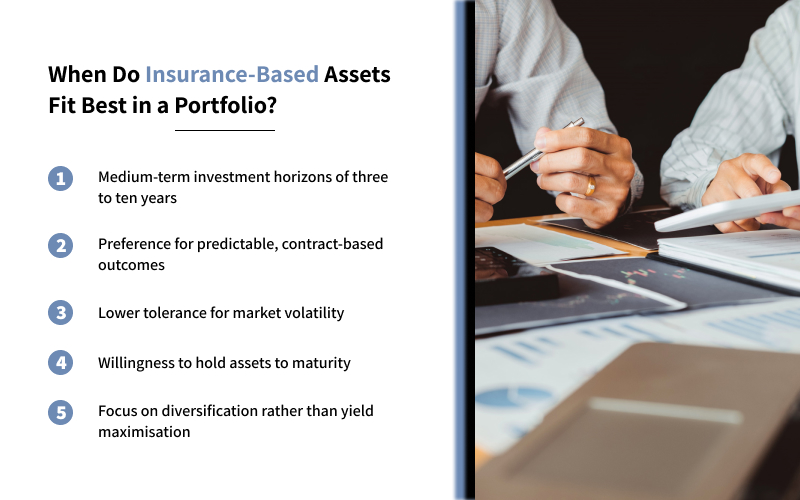
Insurance-based alternative investments are suitable for conservative investors who prioritise clarity, contractual security, and defined outcomes. They are best held to maturity and may not suit investors who require short-term liquidity, frequent access to capital, or market-linked upside.
Clear suitability assessment ensures these assets are integrated intentionally rather than opportunistically.
4.5 Regulatory and tax considerations
Insurers issuing these policies are regulated by the Monetary Authority of Singapore. Secondary transactions are governed by legal assignment rather than product regulation. Investor protection arises from insurer solvency oversight and the enforceability of policy contracts.
Tax treatment varies by individual circumstances. Investors often seek financial planning guidance to understand how maturity proceeds align with their overall tax position.
4.6 Exit strategy and liquidity
Early exit from insurance-based assets is possible but limited. Secondary buyers are selective, and pricing depends heavily on remaining tenure, insurer profile, and maturity size. An investor seeking to exit early may need to accept discounted pricing.
This limited liquidity is a structural feature rather than a flaw. It supports contractual pricing certainty and reinforces the importance of aligning investment horizons from the outset. This makes resale insurance most suitable for investors in Singapore with a long-term holding mindset.
Frequently Asked Questions
Can I sell a traded endowment policy before maturity, and how does that affect returns?
Yes, it is possible to sell a traded endowment policy before it reaches maturity, but the secondary market is limited and buyers are typically selective. Pricing depends on factors such as the remaining policy term, maturity payout amount, insurer profile, and any outstanding premium obligations. Selling early often requires accepting a discounted price compared to the full maturity value, which reduces total returns. For this reason, these policies are generally best approached with the intention of holding them through to maturity.
How much capital is required to start investing?
The capital required varies depending on the size and structure of the policy. Entry-level opportunities often start from around S$50,000 per policy, while investors seeking diversification across multiple policies may allocate S$100,000 to S$200,000 or more. Any remaining premium payments should also be considered, as they affect both cash flow planning and net returns over the holding period.
Are there tax implications?
In Singapore, maturity proceeds from insurance policies are generally not treated as capital gains, but individual circumstances may differ. Tax treatment can depend on factors such as personal income profile and overall financial structure, so investors are encouraged to review their situation with a qualified tax professional to ensure clarity before committing capital.
Conclusion
Insurance-based assets, including traded endowment policies, form a credible segment of alternative investments for Singapore investors seeking predictable, non-market-linked returns. Returns are derived from contractual maturity payouts rather than market performance, typically over three to ten years.
Successful participation requires disciplined policy selection, careful consideration of premium obligations, insurer reliability, legal assignment, and realistic liquidity expectations. When integrated thoughtfully, these assets enhance portfolio diversification and support stable, outcome-driven strategies.
To assess whether this approach aligns with your objectives, or if you are exploring options to sell an endowment policy in Singapore, contact Conservation Capital today.