Endowment Policy vs Whole Life: Which Makes More Sense for Investment Buyers?

Key Takeaways:
Is an endowment policy vs whole life the better choice for investment buyers in Singapore?
- Endowment policies are designed for time-bound savings, offering clearer payout timelines and more predictable capital outcomes at maturity.
- Whole life insurance prioritises lifelong protection, with cash value building gradually and typically requiring a much longer commitment to realise meaningful value.
- Return differences are structural rather than market-driven, with endowment plans often showing stronger visibility over medium-term horizons.
- Liquidity and exit flexibility vary significantly, making it important for investors to understand opportunity cost and structural risk before committing.
- The right choice depends on personal goals, time horizon, and how much flexibility an investor wants as financial priorities evolve.
Introduction
In Singapore, life insurance is commonly purchased to protect loved ones, but many policyholders also view it as part of a longer-term financial strategy. As savings goals, retirement timelines, or liquidity needs change, investors often reassess endowment policy vs whole life to determine which structure better supports capital growth and financial certainty. While both plans fall under insurance-based planning, their objectives, commitment periods, and return profiles differ in important ways. Understanding these differences helps conservative investors make decisions that remain sound over time.
This guide explains how endowment and whole life policies are designed, how returns and risks compare, and what buyers should consider before committing funds.
What Is an Endowment Policy Designed to Do?
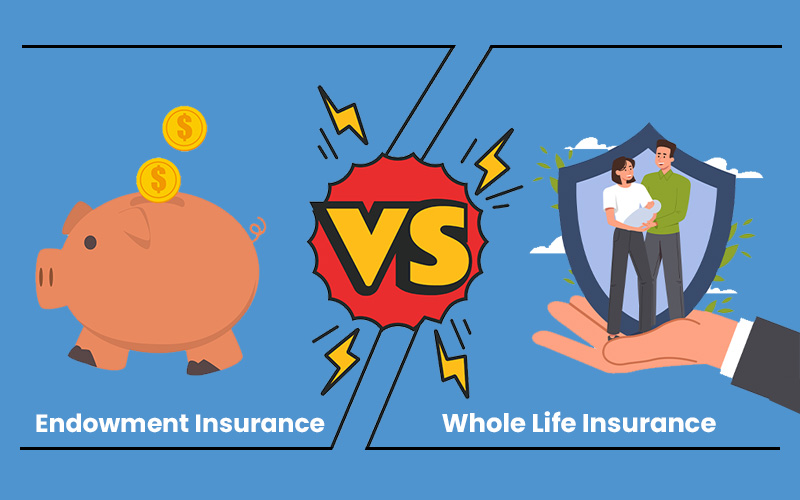
An endowment policy combines insurance coverage with disciplined savings over a fixed term. Premiums are paid for an agreed number of years, and at maturity, the policy pays out a lump sum made up of guaranteed benefits and non-guaranteed bonuses declared by the insurer.
When examining the difference between endowment and whole life insurance, endowment plans stand out for their structure. The policy term, maturity date, and payout framework are set from the start, making them easier to align with medium-term financial goals. For investors, this clarity reduces uncertainty around when capital becomes available and how it can be used.
What Does a Whole Life Insurance Policy Focus On?
Whole life insurance is built primarily around permanent protection. Coverage typically lasts for the policyholder’s lifetime, and premiums support both insurance benefits and long-term savings. Over time, the policy builds whole life policy cash value, which can be accessed under certain conditions.
From an investment perspective, this cash value grows more slowly, especially in the early years, because a larger portion of premiums goes toward maintaining lifelong coverage. This is why comparisons between endowment policy and whole life often highlight purpose rather than performance alone: whole life plans prioritise continuity and legacy planning over near-term returns.
How Do Returns and Commitment Periods Compare?
Endowment plans usually operate over shorter horizons, commonly between five and twenty years. This allows investors to evaluate outcomes within a defined timeframe. In many cases, endowment plans can offer clearer visibility of projected outcomes over a defined term, because the maturity timeline is fixed.
Whole life policies, by contrast, require extended holding periods before meaningful value is realised. The internal rate of return can be less visible in the earlier years, because the policy is designed primarily for lifelong protection. For investors reviewing available insurance investment options, matching the policy structure to the intended time horizon is critical.
It is also important to understand bonus variability. While guaranteed components provide a baseline, non-guaranteed bonuses depend on insurer performance and are influenced by how long the policy is held. Projected figures are therefore indicative, not fixed.
Liquidity, Exit Timing, and Structural Risk
In Singapore, insurance policy transfers are carried out through intermediaries using established policy assignment mechanisms, where ownership, benefits, and premium obligations are transferred to the buyer. While these transactions are not classified as regulated investment products in the same way as unit trusts, they follow recognised contractual processes that provide structure and clarity for policyholders reassessing their options.
The primary risk here is not market volatility, but structural risk. This includes capital lock-in, bonus dependency, and the financial impact of early surrender. Exit outcomes can vary significantly depending on whether a policy is in its early years or closer to maturity.
For Singapore policyholders whose priorities change, explore regulated secondary market routes, such as traded endowment policies, as part of reassessing liquidity and capital allocation.
Which Policy Suits Which Investor Profile?
Choosing between endowment policy vs whole life depends on personal objectives rather than headline returns. Endowment plans generally suit investors who value time-bound growth, predictable outcomes, and clearer capital release. Whole life policies are more appropriate for those prioritising lifelong protection, estate considerations, and long-term continuity.
In reality, financial goals evolve. Career shifts, retirement planning, or portfolio adjustments may prompt a review of existing policies. In such situations, understanding practical considerations, including the process of selling an endowment policy in Singapore through compliant channels, helps investors plan ahead rather than react under pressure.
Conclusion
For investment-minded buyers, choosing between endowment and whole life insurance requires clarity around purpose, time horizon, and flexibility. Endowment policies typically align better with medium-term savings and capital certainty, while whole life policies serve long-term protection needs with secondary savings benefits.
A thoughtful assessment at the outset, combined with awareness of future options, helps ensure that insurance-based investments continue to support evolving financial goals rather than constrain them. For policyholders who later reassess their priorities, understanding the role of companies that buy life insurance policies in Singapore can provide additional perspective on how existing plans may be managed more strategically.
Take the next step by consulting a traded insurance specialist to assess whether your existing policy structure still aligns with your investment objectives.